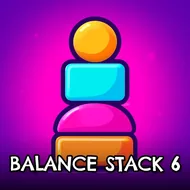
Balance Stack 6
Instructions:
MOUSEDescription
Balance Stack 6 Player Reviews and Tips
Winning Strategies
Every shape drop feels tiny until it isn't, and that's the trap most people fall into during their first few runs. Cubes are forgiving, sitting flat and steady, but the moment a cylinder or sphere shows up you have to slow your mouse hand way down and nudge instead of drop. A lot of players just click and hope, which works fine at level three and falls apart completely by level fifteen. The trick that actually holds up is watching the center of the piece you're already holding before you release it, not just eyeballing the top of the stack. Triangles are the real test since they tip if your placement is even a hair off center, so lining them up dead-center on whatever's beneath them buys you way more room for error later when the tower gets tall and wobbly.
The difficulty curve here isn't gentle, and it's not trying to be. Early levels ease you in with predictable shapes, but the game mixes the order randomly the higher you climb, so muscle memory alone won't carry you to level 50. There's no story dressing this up, no characters, no cutscenes explaining why you're stacking things — it's just you, a shaky tower, and a countdown timer once the last piece lands, checking whether your creation actually holds or crumbles into a heap.
Standout Features
- Five distinct shapes — cube, triangle, cylinder, sphere, and rectangle — each with its own balance quirks
- Random shape order per playthrough, keeping runs from feeling repetitive or memorized
- A stability timer after the final piece that adds a genuine hold-your-breath moment
- Simple mouse-only controls, easy to pick up for kids or casual players alike
- Fifty levels of ramping challenge for anyone chasing a longer completion goal
- Clean 3D presentation that keeps the focus purely on physics and precision